The usable time-dilation of a Kerr flyby is geodesic
What observer-to-proper-time ratio a returning spacecraft can collect, once the exit is limited to published plasma and nuclear-thermal plants
doi:10.5281/zenodo.22685272 · published in Zenodo, CC BY 4.0
What this article is. A calculation, with published engines, of the time-dilation ratio available to a spacecraft that leaves an equatorial encounter with a Kerr black hole. The title is the result. v1.4 corrects the two-branch reading of v1.3 (E-family was never below the escape threshold) and adds the near-separatrix returning family S ( exterior zoom-whirl). E/C encounter values remain author-frozen from v1.0–v1.3. v1.1 expanded the prose. v1.2 and v1.3 applied accepted errata from two independent audits (18 August 2026). Cite the Zenodo version of record at doi:10.5281/zenodo.22685272 (concept 10.5281/zenodo.22003171; the version DOI updates on new deposit). v1.4 supersedes v1.3 at the same concept DOI.
What it is not. It is not a technical note of the ElarionX CPMS Cryogenic Referent Registry (Notes 000–004, Zenodo records 10.5281/zenodo.21895568, 21895605, 21895647, 21895743, dataset 21895803, and Note 004 at 10.5281/zenodo.22684011). It does not belong to that series, does not share its numbering, and must not be deposited as a new version of those records. It is not a paper about cryogenic tanks, boil-off, or model validation. It is not a time-machine paper. The imprint is ElarionX, not ElarionX CPMS.
On the title. Propulsion does not control time. It selects a worldline. Different worldlines accumulate different amounts of proper time relative to a distant observer. That is the twin paradox in Kerr spacetime, not a change of causal structure. A large ratio that cannot be collected on a returning trajectory is not a usable ratio. Geometry already supplies the interesting returning worldline: the near-critical parabolic zoom-whirl. Published plasma and NTP do not appear to move that frontier.
I. Why this question
People hear “black hole” and “time” in the same sentence and reach for one of two pictures. The first is a machine: a device that sends a signal, or a person, into the past. The second is a tourist twin-paradox: park near the horizon, wait, come home younger by years. Both pictures skip the only part that costs fuel.
Staying is cheap. A circular geodesic outside the innermost stable circular orbit needs no thrust. A plunge needs no thrust. The spacetime does the work. The clock ratio on those worldlines can be large. The bill is not for sitting. The bill is for leaving.
A spacecraft that is to be compared with a twin on Earth has to return, or at least recede to a region where Boyer–Lindquist and proper time again run together. Return is a change of conserved energy and angular momentum. That change is a . The is spent where the geometry is least forgiving, in a window of proper time that shrinks as the hole gets smaller and as the four-velocity gets larger. The engineering question is therefore not “how much time-dilation does a Kerr hole offer?” It is narrower, and it is the question this article answers:
What can a spacecraft that leaves a Kerr equatorial encounter collect, if exit is limited to published plasma and NTP?
The plants admitted here are electric and plasma thrusters with a public thrust and specific impulse, and nuclear-thermal rockets with a public chamber rating (NERVA-class and the later NASA SNP targets). Nuclear-pulse (Orion) and fusion concepts appear only as labelled study bounds, not as hardware. The Penrose process is out of scope. If the returning ratio is just the geodesic flyby, that is the result. A null answer publishes.
“Null” here does not mean that Kerr dilation is small. It means that the usable dilation, the number a returning vehicle can put next to an Earth clock, is the geodesic flyby. The large local factors are real. They are not collectable on a worldline that also satisfies the exit constraint. That is a negative engineering result and a positive bookkeeping result: it tells the next calculation where not to look.
I am writing this as a first-person calculation, not as a collaboration and not as an agency study. The geometry is standard. The engines are taken from the public design record. The only original step is to refuse to treat a capture ratio as a flyby ratio, and to refuse to treat a study as a plant.
The popular literature does not make that refusal. A figure of at the ISCO, or of on a plunge, is printed next to a drawing of a ship, and the caption lets the reader infer that the ship comes home. I have done the opposite. The ships that come home are the E family of §III and the near-separatrix S family of §III.A. The large numbers that do not come home sit on the C family and on the circular stays of §VII. If that partition is the whole result, it is still a result. Publishing it keeps the next person from spending a year rediscovering that the exit, not the clock, is the obstruction — and that the live engineering problem on the returning side is control authority around , not a periapsis burn that rescues C2.
There is also a narrower reason to write it down now. I maintain a separate series of cryogenic-tank notes under a different imprint discipline. This calculation is not one of those notes. Putting it in a file that says so, with the Zenodo records of Notes 000–004 named, is part of the work. A reader who arrived from that series should stop at the box and treat this as a different paper.
II. The clock we actually use
Units throughout: , , signature . Radii in units of . Spins , , and . The last is Thorne’s astrophysical disk-spin cap, not extremal Kerr; a thin disk with the usual radiation-capture argument does not spin the hole past that value. The motion is equatorial and prograde. The Carter constant is . Charge is zero. The spacecraft is a test particle: its stress-energy does not source the metric at this order.
The distant-observer time is Boyer–Lindquist . It is the Killing time of the stationary field . A clock at spatial infinity, at rest with respect to the hole, reads . The spacecraft proper time is the arc-length of its worldline,
The ratio along a finite segment of worldline is
the path average of the time-component of the four-velocity. That is the clock this paper uses. It is not a local redshift measured by a hovering observer, and it is not the difference .
The difference is a bad objective. It is dominated by any stretch where , and it grows with how long one chooses to wait in such a stretch, even if the interesting encounter is unchanged. A year of cruise at adds a year to and a year to and adds nothing to : the two clocks advance together. (A residual offset already earned earlier in the trip is simply carried along; cruise at does not enlarge it.) An optimisation that maximises is then an optimisation that maximises dwell where , or trip length in a poorly chosen functional — not the twin-paradox ratio on a finite encounter. That is not the twin-paradox question this paper asks, and it is not an engineering figure of merit for a flyby. The figure of merit used here is the encounter ratio on a declared cut.
I labour this because it is the mistake I made first. A plot of against periapsis looks dramatic: closer flybys produce a larger difference. They also take longer in coordinate time if one includes more of the cruise, and they produce a larger difference if one simply waits. The ratio on a finite window is the quantity that can be compared across trajectories of different duration. The path-averaged is that ratio. Once that is granted, the identity is immediate and has to be faced.
For a geodesic that starts at infinity with conserved energy and returns to infinity, in the infinite-cut limit by identity. Both clocks accumulate without bound. The deep dwell contributes a finite and a finite . Once those finite pieces are diluted by an arbitrarily long cruise, the ratio approaches 1. This is not a numerical accident and it does not depend on spin. It is the statement that an geodesic is asymptotically Minkowski at both ends. At any finite observer radius the identity is cut, not exact. I checked it at . On the four escaping E geodesics of §III, . On the near-separatrix S family of §III.A the residual is of the same order and grows mildly with whirl number (slopes and per unit at and ; all ). That residual is the remaining dilution at the cut, not a physical prize, and it is not claimed to vanish identically at finite . The paper therefore does not maximise . In the infinite-cut limit that number is 1 for every return.
What can be registered, without lying about the identity, is an encounter ratio: integrated from periapsis out to a conventional cut, and back again for an escaper, together with the peak at periapsis. The cut used here is . Fifty gravitational radii is far enough that has already fallen close to 1, and close enough that the number still describes the encounter rather than the cruise. Changing the cut changes the decimal. It does not change the claim, which is that published thrust does not move the escaping geodesic onto a capture-class worldline and back. The cut is a convention, not a unique physical surface, and it is not sold as one.
A different conventional cut — , , a fixed , a photosphere multiple — would be equally legitimate if it were declared. I chose because it is outside the photon region and the ISCO for every spin in the table, and because the E-family has already dropped to the 1.10–1.13 range there. Tightening the cut raises those decimals a little; loosening them drops them toward 1. Neither operation turns an E trajectory into a C trajectory, and neither operation is a propulsion result.
A capture that never leaves is a different functional. Its diverges if the inward cut is pushed toward the horizon, because diverges there and the integral has no compensating outbound leg. Capture and escape are not compared as if they were the same mission. Figure 1 will make that visible; the tables already do.
Escape, after burnout, means and no blocking exterior turning point on that would trap the spacecraft short of infinity. For the prograde threshold is the marginally bound circular orbit. In these units
The numerical values used later are and ; the corresponding circular values are and . is the unstable circular orbit at .
The radial potential at has two radially disconnected branches when . On the exterior branch a turning point sits outside : a geodesic that arrives from infinity turns there and returns to infinity (scattering). On the interior branch a turning point sits inside the barrier: the geodesic plunges toward and never reaches infinity. The inequality is the same (); the branch is not. C S, and E is exterior scattering, not “ below threshold.” At a geodesic started from an interior turning point is homoclinic: it approaches asymptotically and does not cross. Homoclinic is not “almost escaped.” Leaving the interior well at requires lowering through (strictly after the burn) and enough energy that a pure-azimuthal burn does not drop the trajectory below . Those two conditions are not the same, and §IV will show that a cheap -only burn fails the second even when it appears to meet the first. The near-separatrix exterior family with () is Table S in §III.A: it leaves, whirls, and carries the returning toward .
It is useful, in words, to split the way a zero-angular-momentum observer (ZAMO) splits it. The ZAMO is the local observer who is dragged with the hole but carries no angular momentum of his own. Between the ZAMO’s proper time and Killing time there is a lapse : gravitational redshift, frame-dragging included. Between the spacecraft and the ZAMO there is an ordinary special-relativistic Lorentz factor . The product is the identity
A large can therefore be gravitational (small , deep in the well) or kinematic (large , fast relative to the local ZAMO), or both. The encounter ratios of §III are averages of that product. The exit of §IV is a change of the ZAMO three-velocity, which changes and together. Writing ignores both the lapse geometry in and the factor that appears when one differentiates . That naive map overstates the ticket by about five. The split is the reason.
Interior Cauchy-horizon chronology is not used. Closed timelike curves in Kerr live inside the inner horizon . This paper’s trajectories stay at , or they fall across and the calculation stops. Hawking’s chronology-protection argument and the Poisson–Israel mass-inflation instability are cited in §XI only to locate that exclusion, not to analyse the interior.
The test-particle condition is the other exclusion that belongs in this section. A real spacecraft has mass, a finite size, and (if it is Case B) a megawatt of beamed power. None of that is in the metric. Self-force, radiation reaction, and the spacecraft’s own stress-energy are higher-order corrections on a stellar-mass or supermassive background. They do not buy an exit . Treating them as a hidden propulsion channel would be a different paper and, on present evidence, a wrong one.
III. How a geodesic is integrated
A second person should be able to reproduce the table in this section from the first integrals, without a private code base. The integrals are Carter’s (1968), written in the Bardeen–Press–Teukolsky (1972) radial form. The metric is Boyer–Lindquist (1967) on the Kerr (1963) spacetime.
The metric functions needed on the equator are
( reduces to at ). The event horizon and the inner horizon are the roots of ,
With this is . The conserved energy and axial angular momentum of a test particle of rest mass 1 are and . The Carter constant is on the equator, and identically if the motion starts equatorial. Define
The radial potential is
Turning points are the roots of . The first integrals for Killing time and radius, still at , are
Mino time , defined by , removes from the radial equation:
The encounter ratio is then the quadrature
because . The integrals run between the cuts stated below. Near a simple turning point , vanishes linearly, so and a naive step in is singular. The integrals used for the E/C table are Gauss–Legendre in the regular coordinate . An 18 August 2026 recompute recovered the eight E/C encounter values and the ZAMO tickets to the printed decimals (on C2 at the plunge differs at the last printed digit: 79.51 here; 79.49 in one recompute; relative scatter , coarser than a claimed ). The E/C split does not move. Those eight E/C values are author-frozen for v1.4; this draft does not re-integrate them. The S-family numbers of §III.A were produced by a separate Mino-time / hybrid integrator (DOP853) and independently reviewed for algebraic and monotonicity checks (PASS_WITH_FLAGS, 10 September 2026); that peer review is an independent check of the S numbers, not a second codebase implementing the E/C recipe from scratch. Appendix A restates the E/C cuts and checks as a recipe. Until a second implementation of that recipe is run by another codebase, the correct audit label for a fresh E/C recompute request remains: match the frozen table, or report UNVERIFIED — do not silently retune .
Circular-orbit radii and four-velocities are not integrated; they are algebraic. The prograde ISCO is Bardeen–Press–Teukolsky (1972),
The specific energy and angular momentum of a prograde equatorial circular geodesic (Bardeen, Press & Teukolsky 1972, ) are
The circular angular velocity and are
Those are the columns of the first table. The ISCO column is the largest stable circular geodesic ratio. It is free of thrust. It is also a stay: leaving it costs the in the last column, of order –.
Radii used below (prograde):
| 0 | 2 | 4 | 6 | 1.41421 | 0.05719 |
| 0.9 | 1.43589 | 1.73246 | 2.32088 | 2.69638 | 0.15575 |
| 0.998 | 1.06321 | 1.09144 | 1.23697 | 10.79094 | 0.32099 |
Encounter ratios for the family, computed from the first integrals in Mino time as above. Escape: . Capture: inward from the interior turning point to . The factor 0.2 is a cut, not a horizon; it keeps the quadrature off the coordinate singularity at while still sitting on the geodesic.
| id | leaves? | ||||
|---|---|---|---|---|---|
| E1 | 0.9 | 4 | 3.29761837 | 1.13076 | yes |
| E2 | 0.9 | 8 | 4.35761026 | 1.10408 | yes |
| C1 | 0.9 | 1.50 | 2.75147186 | 19.912 | no |
| C2 | 0.9 | 1.65 | 2.64020549 | 9.070 | no |
| E1 | 0.998 | 4 | 3.24369872 | 1.12893 | yes |
| E2 | 0.998 | 8 | 4.33380971 | 1.10368 | yes |
| C1 | 0.998 | 1.07 | 2.09894233 | 138.70 | no |
| C2 | 0.998 | 1.08 | 2.09123916 | 79.51 | no |
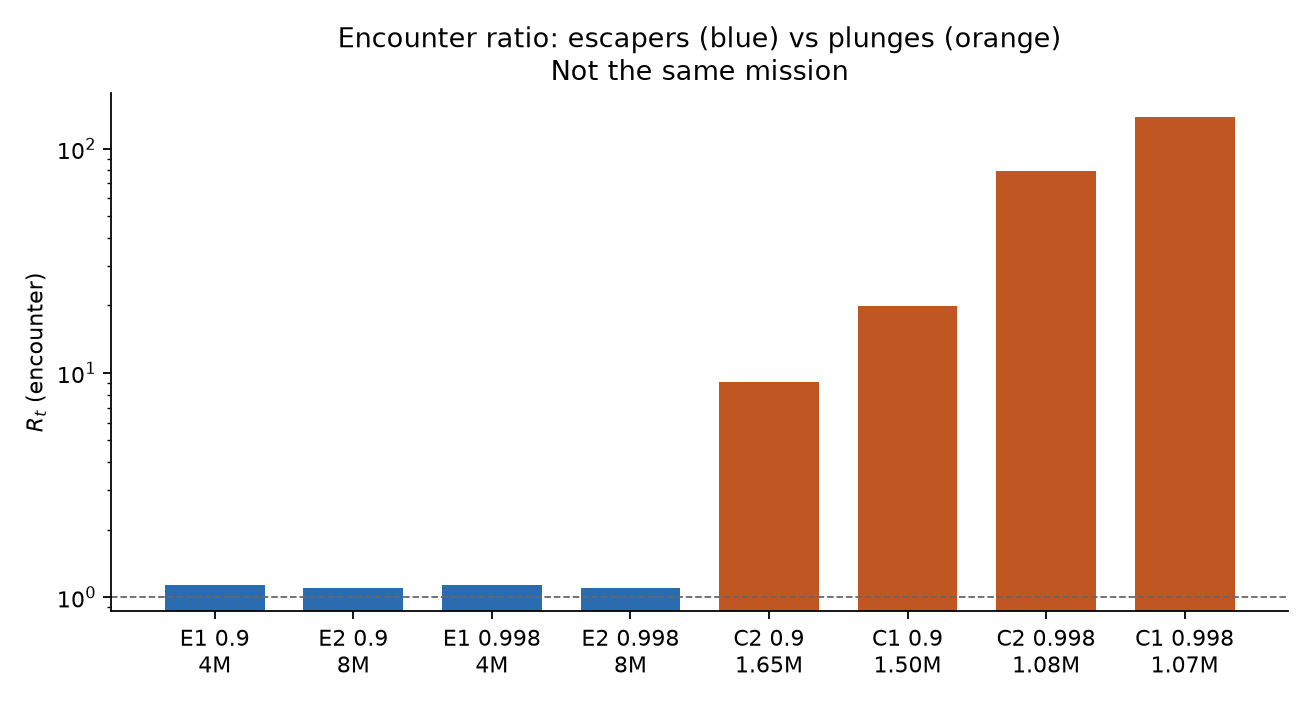
Instantaneous at the turning point (this is not ; it is the factor that enters the ZAMO split). On the escaping flybys (E1/E2) the peak at periapsis is mild: E1 , E2 . On the interior plunges (C rows) the peak at the interior turning point — not a flyby periapsis — is large: C2 / , C1 / (0.9 / 0.998). The escaping flybys are only mildly relativistic relative to the local ZAMO. The plunges are not. Do not quote a C-row peak as a returning-flyby periapsis peak.
The shallow E-family encounters at and buy ten to thirteen percent in the window (–). That is not the ceiling for a geodesic that leaves. As on the exterior branch, the whirl-averaged climbs toward — about at and about at — while the trajectory still leaves (family S, §III.A). The large C-row numbers remain plunges: they do not return. C1 at , does not admit a cut at , because that cut lies outside the turning point; the 0.2-cut still lives on the geodesic. A reader who tightens the capture cut toward the horizon will see grow. That growth is not a flyby.
The C family and the E family are different missions, and both differ from S. The E trajectories come from infinity on the exterior branch, turn at , and go back to infinity. Their lies above ( to on the frozen rows); that is why an exterior turning point exists and why they leave without a burn. They are not “below the escape threshold.” The C trajectories are not many-orbit wells and they are not bound ellipses. Each C initial condition is the apoapsis of an interior plunge: from , runs toward . One pass. also, so there is a barrier between the interior well and spatial infinity — same inequality as E, different branch. The spacecraft is already at ; energy is not what is missing. Angular momentum is. Leaving that family at is done by lowering , which is the subject of the next section. C S: S is exterior scattering with ; C is an interior-well plunge.
Why start the C family at rather than at a bound energy? Because is already the cheapest energy at which escape is possible. A bound C-like well would need a still larger on top of the . Starting at is the generous choice. The remaining obstruction is the barrier in . If published plants cannot lower through that barrier on one pass, they cannot do it from a deeper energy either.
How the C rows were placed: is chosen above so that an interior turning point exists at the listed , close enough to that is large and far enough that the 0.2-cut still sits on the geodesic. C2 is the cheaper ticket. C1 is the deeper well. Neither is a captured circular orbit; both are plunges that have not yet reached the horizon. The word “capture” in the table means “does not leave,” not “has already crossed .”
I tabulated both families in one place so that a large C number cannot be quoted as if it were a returning flyby. Figure 1 is the same warning in a bar chart.
The vertical axis of Figure 1 is logarithmic because otherwise the E bars are invisible next to C1 at . That invisibility is the claim.
III.A. Near-separatrix returning family S
The shallow E rows at and are exterior scatterers far above . Geometry supplies a deeper returning worldline on the same exterior branch: set and with . The periapsis drops toward , the trajectory whirls, climbs toward , and the spacecraft still leaves. That is family S. It is not a C row with the labels swapped.
Frozen definition of whirl number. Over the full encounter (inbound plus outbound),
Report the continuous value; the floor is optional bookkeeping. This definition is not redefined mid-paper.
Primary LOCK rows (S9e2–S9e5, S998e2–S998e5). Optional rows appear only in Appendix D. Encounter on the E/C table remains author-frozen; the S numbers below are new for v1.4 and were peer-reviewed independently (PASS_WITH_FLAGS). Soft status OK_LOOSE_ONSHELL on early- rows (onshell_rel ) is a numeric diagnostic, not a dynamical failure, when leaves=yes.
| id | (whirl) | (, one-way) | leaves | status | ||||||
|---|---|---|---|---|---|---|---|---|---|---|
| S9e2 | 0.9 | 2.65878009 | 1.94037826 | 1.1725 | 3.86753 | 1.19914 | 4.239493 | yes | OK_LOOSE_ONSHELL | |
| S9e3 | 0.9 | 2.63508799 | 1.78973179 | 2.2940 | 4.49193 | 1.24474 | 5.229931 | yes | OK_LOOSE_ONSHELL | |
| S9e4 | 0.9 | 2.63271878 | 1.74978878 | 3.3762 | 4.82126 | 1.28934 | 5.613688 | yes | OK_LOOSE_ONSHELL | |
| S9e5 | 0.9 | 2.63248186 | 1.73786093 | 4.4551 | 5.01897 | 1.33306 | 5.743537 | yes | OK | |
| S998e2 | 0.998 | 2.11033715 | 1.16157507 | 5.0379 | 14.93716 | 1.36823 | 19.622753 | yes | OK_LOOSE_ONSHELL | |
| S998e3 | 0.998 | 2.09153216 | 1.10800589 | 10.8981 | 22.07191 | 1.57895 | 33.087171 | yes | OK | |
| S998e4 | 0.998 | 2.08965166 | 1.09618045 | 16.9304 | 26.62023 | 1.79437 | 39.938099 | yes | OK | |
| S998e5 | 0.998 | 2.08946361 | 1.09289284 | 22.9816 | 29.61752 | 2.00830 | 42.526575 | yes | OK |
Reference limits: , . As , , , and (whirl) rises toward those limits while every primary row leaves.
Residual disclosure (required). At finite , the out-and-back ratio satisfies on every S row, but grows mildly with (peer-review slopes at and at ). The manuscript does not claim as a finite- identity; the infinite-cut limit remains 1, and the measured residual at is the cut.
Method sketch: Carter first integrals, Mino time near periapsis with on-shell projection, DOP853 hybrid switch to an -IVP outside a match radius; and held as Carter constants. Full diagnostics live with the frozen CSV companion to this version; they are not re-printed here.
The engineering reading follows at once. Ten to thirteen percent at shallow was never the returning ceiling. The interesting returning geodesic is already on the table: near-critical parabolic zoom-whirl. Published plasma and NTP, as argued in §V–§VI for the C exit, do not appear to move that frontier by buying a C2 rescue. The live problem is control authority around on an exterior worldline that already leaves — not a burn that converts an interior plunge into a return. Self-force and a quantitative for that authority are not computed here (OPEN; no invented numbers).
IV. What “leave” means
The effective-potential language is the usual one. At fixed and , the radial motion is that of a particle in the potential defined by at the turning points. For there is a critical angular momentum . Above an exterior barrier separates an interior well from infinity: the exterior branch scatters (E and S); the interior branch plunges (C). Below the barrier is gone and an trajectory that is outside the horizon runs to infinity without an exterior turn — which is how an interior occupant must leave, and which is not the E/S exterior flyby. On the knife-edge the barrier height is exactly zero at : that is the unstable circular orbit, and a trajectory that approaches it from inside is homoclinic. It does not escape. Homoclinic is not “almost escaped.” It is a different topological class.
The C trajectories already have . They sit in the interior well with . Leaving at means lowering until the barrier disappears. Lowering is a burn. The cheapest-looking burn is a 3-force along the ZAMO azimuthal leg at periapsis, where and every bit of impulse goes into . That is the map I compute. It is a map, not a solved optimal-control problem.
“Leave” is used in one sense only. After the burn, the new must have no blocking turning point on and must satisfy . Coasting toward and lingering there is not leaving. Crossing is not leaving. Reaching on a trajectory that still has an exterior apsis that returns it to the well is not leaving; that is a bound excursion. The E and S rows of §III / §III.A already satisfy the definition without a burn — they are on the exterior branch. The C rows do not.
| id | \Delta v_\hat\varphi (km/s) | ||
|---|---|---|---|
| C2 | 0.9 | ||
| C2 | 0.998 | ||
| C1 | 0.9 | – |
Method, in enough detail to check. At periapsis , the specific angular momentum and the ZAMO azimuthal speed are related by . A 3-force along therefore changes at the rate that follows from differentiating at fixed . Because , the finite ticket is
on these perihelia is of order –. The naive conversion drops both and the distinction between and . It overstates the ticket by a factor of about five. I mention the naive number only so that a reader who recomputes that way does not think the paper’s tickets are too small. C2 is still in the linear map; C1 is not, which is why C1 is quoted as a range. The finite-difference map (same formula, exact, ) is 270.19, 89.01, and 3846 km/s.
does not escape (homoclinic). on C2 at does, and yields . That is the prize if a cheap save onto the threshold geodesic had worked. It is 1.42, not 9, and if the observer cut goes to infinity, again. A pure- burn that makes the tabulated also drops (C2 at goes to ) and still fails: the trajectory is below the barrier in but no longer at , and a new exterior turning point appears. The burn has to buy and together. Energy and angular momentum are coupled through the same impulse.
This is a periapsis map. A cleverer steering — a short radial component, a burn slightly off periapsis, a two-impulse sequence — will move the point in the plane along a different curve. The distance in that plane from C2 to the escape region is finite (–, or if is held). It is not seven orders of magnitude. The paper states the unsolved steering as a limitation in §X, not as an open hope that closes the null. Seven orders is the gap between published plasma in the window and the ticket, not the gap between this map and the optimal map.
The 1.41655 figure is the other check on this section. If lowering by a token below on C2-0.9 produced a capture-class , the title would be in trouble: a tiny, almost free, adjustment would have bought a large returning ratio. It does not. The saved geodesic is an escaper from the interior side of the threshold. Shallow exterior escapers live at 1.10–1.42 in the window; near-separatrix exterior escapers (family S) carry a larger whirl-averaged while still leaving. The prize for a successful cheap C2 save is still a geodesic — and it is not a reason to quote C2’s plunge as returning.
V. Published plants
Constants: , . Mass flow is counted in proper time, . Exhaust is non-relativistic for every plasma and NTP number below; the relativistic rocket equation is not needed and is not used.
Proper-time mass flow is the conservative choice for the spacecraft. Near periapsis the spacecraft’s clock is the slow one, so a given thrust burns the tank faster per unit Killing time than the same thrust at infinity. I do not take credit for that. The window arithmetic of §VI is even more conservative on the plasma’s side: it uses Case B’s at , as if the engine were in flat space for the whole 15.5 s.
What is admitted as a plant is a published thrust and a published specific impulse tied to a real design or a public target. What is labelled “study” is a number that exists on paper and has not been a rated chamber or a flown cluster. The distinction is the whole point of the title. A study that closes the rocket equation does not refute a claim that is conditioned on published plasma and NTP.
I am aware that “published” is a line one can argue about. NERVA ran. Phoebus-2A ran, at a higher thrust than the 75 000 lbf mark used below; I do not attach that firing to the 334 kN row. The SNP 900 s / 12 500 lbf point is a NASA target in a public NTRS paper, not a chamber that has been accepted at that rating; I still admit it, because it is the present public NTP mark and because admitting it makes NTP look better than 1972, not worse. DRACO is the opposite case: a cancelled demonstration does not raise , so it contributes nothing to the table. Orion and Dyson are studies in the strict sense. They have first-author papers and they do not have a rated pulse unit that I can put next to NERVA Alpha. If a later program rates one, the table gets a new row. Until then they stay labelled.
Case A, debug / near-term Hall (SPT-140 class): , , . Initial acceleration . This is the kind of thruster that exists on spacecraft. It is in the paper so that “plasma” is not an abstraction.
Case B, constructed reference architecture (not a single flown engine): an ambitious nuclear-electric cluster assembled from published AF-MPD / VASIMR-class points, scaled to . Parameters used here: , , , . . Ideal . Full-burn time at : 113 days. Public electric ceiling: –. Case B is the most generous plasma I am willing to treat as a plant-class bound. It is already a megawatt-scale cluster on paper, not a laboratory thruster and not a primary flight article.
NTP, published designs, not a paper architecture:
- NERVA Alpha (1972 reference engine): , , engine mass , two-hour rating. Hydrogen is the propellant. That is the only place hydrogen appears in this article, and it appears as a rocket-equation exhaust, not as a tank model.
- NASA SNP target (Polzin et al., SciTech 2024, NTRS 20230018490): hydrogen outlet goal , , thrust ().
- NERVA 75 000 lbf-class design point, used here as a high-thrust NTP mark: at . This is not a Phoebus-2A firing number.
- DRACO (NASA/DARPA NTP demo) was cancelled in 2025. It does not add a higher , and I do not take a number from a cancelled demonstration as if the demonstration had run.
Study bounds, labelled, not hardware. Orion-class pulse: 2000 s (original) to 6000 s (Air Force plan). Dyson 1968 fusion-pulse discussion: . Case C of a propulsion brief that lets is a physical bound, not a plant. Orion and Dyson close some of the rocket-equation rows below. They are not admitted as plants that refute the title. A reader who wants to reopen the title under a pulse or fusion assumption is writing a different paper; that paper should say so.
Rocket equation, mass ratio , for the three tickets. Exhaust velocities are with the above. Appendix B writes the 89 km/s / 900 s line in full.
| plant | (km/s) | C2 0.998 (89 km/s) | C2 0.9 (270 km/s) | C1 0.9 (3700 km/s) |
|---|---|---|---|---|
| chemical LH2/LOX, 450 s | 4.41 | — | ||
| NTP 900 s | 8.83 | — | ||
| NEP / Case B, 5000 s | 49.0 | 6.14 | 246 | — |
| Orion study, 6000 s | 58.8 | 4.54 | 98 | — |
| Dyson fusion study, 75 000 s | 735 | 1.13 | 1.44 | 153 |
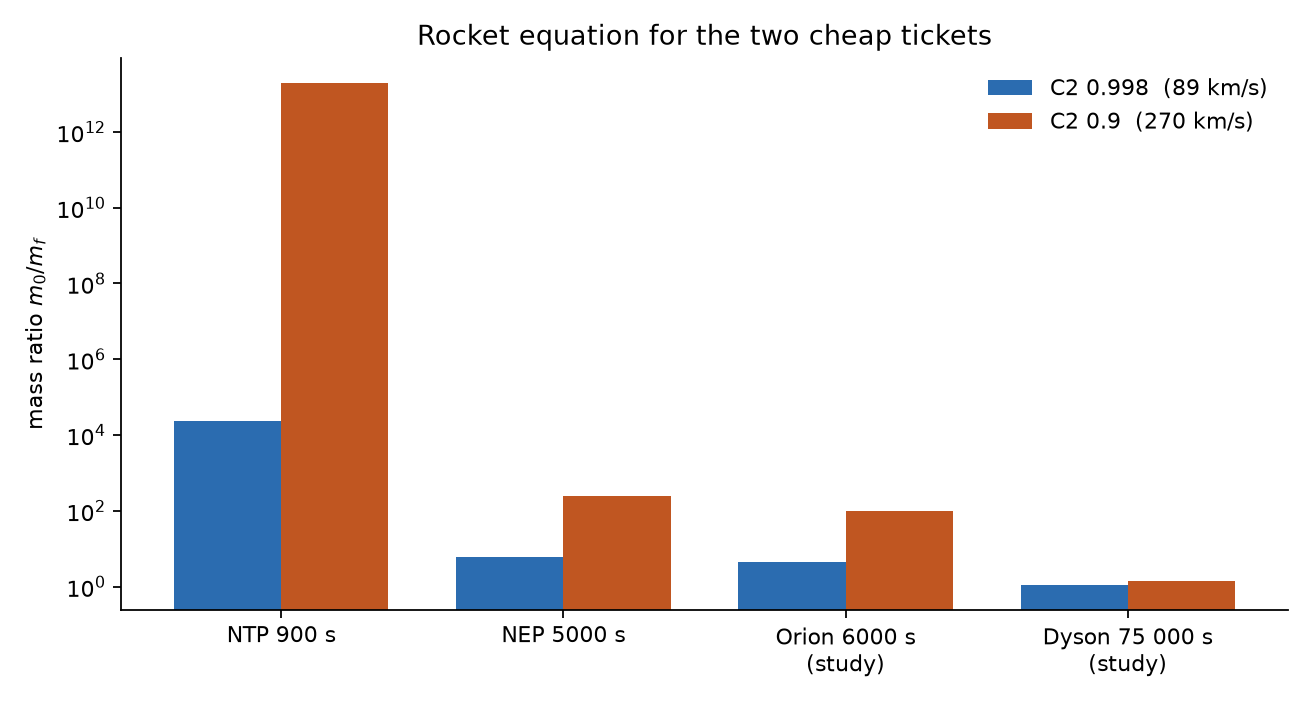
NTP is excluded by identity for both C2 tickets. A mass ratio of is not a spacecraft; a mass ratio of is a sentence, not a vehicle. Case B can buy 89 km/s in 238 days of continuous burn, and 270 km/s only at a mass ratio of 246. Two hundred and thirty-eight days is a cruise far from the well, not a periapsis save. The window of §VI is seconds, not days. I will not add those 238 days to the encounter integral and call the result a flyby ratio.
A stage of mass ratio 10, for scale: NTP 900 s gives ; Case B, ; Orion 6000 s, . None of those numbers is a C1 ticket. Only the 1968 fusion figure is comfortable on C2, and it is a paper. Comfortable on C2 is still not a C1 ticket except at Dyson’s figure and a mass ratio of 153, which remains a study row.
VI. The window
Near the hole the limiting quantity is thrust-to-mass, not specific impulse. Specific impulse sets the mass ratio for a given if one has the time to burn. The pass does not give that time. A periapsis burn has to happen in the pass. Once the spacecraft has receded, the same is no longer the Oberth ticket computed at , and the interior-well barrier is no longer the one being crossed.
The clock used for the window is Keplerian, eccentricity 1, true-anomaly window , at the C2 perihelia. It is a labelled upper bound on the plasma’s chance, for two independent reasons. First, a hyperbolic or parabolic Newtonian pass spends more proper time at a given true-anomaly width than the corresponding Kerr geodesic, because Kerr at those perihelia is 7 to 59 and shortens the proper time in a given coordinate-angle window. Second, is already a wide gate for a burn that is supposed to be a periapsis map. A reader who narrows the gate makes the plasma look worse, not better. A preferred Kerr window using the geodesic on the same angle gate is OPEN in this draft: it has not been fully recomputed as a tabulated Kerr number here. When computed it is expected to be shorter than the Kepler bound (Appendix C); until then the Kepler figures remain the labelled upper bound, not a Kerr clock.
Fiducial masses: a hole, and Sgr A* at . Case B at , which again overstates the plasma’s proper-time thrust:
- , : . Window .
- Sgr A*, same geometry: . Window .
C2 at asks for in that 15.5 s: . A 72 kN NERVA then accelerates 12 kg; a 334 kN NERVA 75 000 lbf-class chamber, 58 kg. The engine masses are tonnes. At the same ticket is . Appendix C writes the arithmetic.
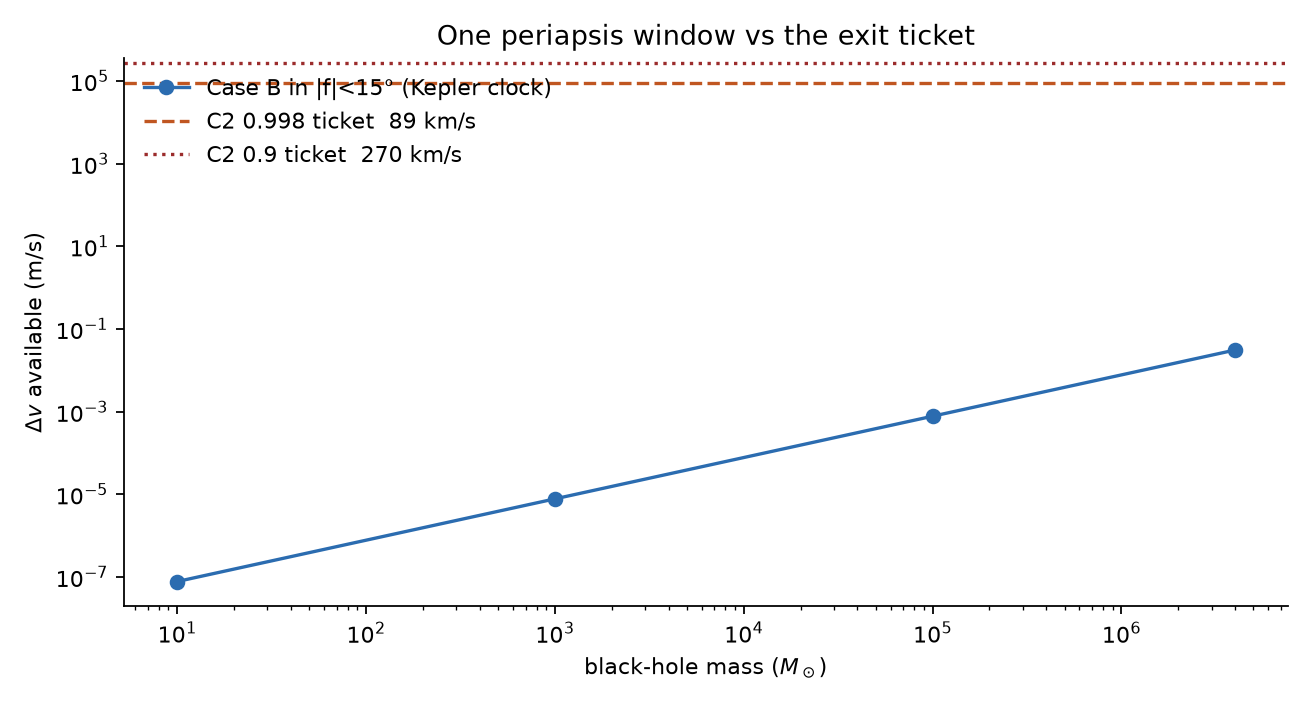
About six and a half orders below the cheap C2 ticket at Sgr A* (Case B, 3 cm/s against 89 km/s), on the one radial pass the geometry allows. A stellar-mass hole is about twelve orders, not six. A stellar-mass hole is not a more usable flyby; it is a worse one. The window shrinks linearly with , the ticket in km/s does not, and the required acceleration goes as . Anyone who wants a large encounter on a stellar-mass hole and also wants to leave is asking for an acceleration that no published chamber produces.
Sgr A* is the generous end of the mass range I am willing to plot. Larger holes exist, and the window grows with . The tickets in km/s do not grow with ; they are geometric. A still larger hole would move the Case B curve in Figure 3 up, linearly. Closing six and a half orders that way asks for a hole far above any galaxy I am prepared to name, and it is not in this paper. I mention the scaling only so that “pick a bigger hole” is not left as an unexamined out.
I am not selling the Kepler clock as a Kerr clock. It is a labelled upper bound, and the Kerr correction goes the wrong way for the plasma. The Kerr analogue remains OPEN as a preferred number for a later patch; no invented Kerr-window seconds appear in the tables.
Thrust-to-mass is the reason NTP appears in this section at all. NTP loses the rocket-equation comparison to NEP by a large factor, and it wins the window comparison by a large factor, because a 70 kN class chamber on a small mass produces a large . It still loses the window, because 587 on a tonne-class engine is not a 12 kg vehicle with a 2.5 t chamber. The arithmetic is in Appendix C. I include NERVA Alpha and the 75 000 lbf-class mark here so that no one can say the paper ignored high-thrust thermal rockets and looked only at Hall thrusters.
VII. Attempts to break the claim
The claim was attacked before it was written down. Each attack is a different worldline, and each fails for a stated reason. I am not looking for a way to save a preferred answer. I am recording the ways that looked, at first, as if they might move the title.
Many orbits in the interior well. If the C initial conditions were a bound carousel, a centimetre-per-second plasma might accumulate over many passes. They are not a carousel. They are a single inward radial pass from apoapsis to the horizon: only for , and just outside, so there is no second turning point. Azimuth can still wind (about eleven turns on C2 at ). That is not a second periapsis. Plasma centimetres per second do not accumulate on a trajectory that has no second radial period.
Hover, or circularise and sit. Hovering is not a geodesic. Case B’s cannot cancel the local gravitational acceleration near . A stable circular geodesic outside the ISCO can be sat on for free, and at the ISCO itself is . That is a real ratio. It is also a stay. Leaving it is the bill. A linear Oberth estimate for the circular-to-escape is at that ISCO. A local ZAMO -boost to is smaller, . At and the same boost is and . Case B has 25.05 km/s. Both ISCO numbers dwarf it. The circular orbit a published plant can leave is so far out that . Sitting is free. Returning from the sit that has a prize is not.
Linger, then leave, as a bound ellipse. Same energy wall. A bound ellipse with apoapsis far out and periapsis in the well is a stay that periodically visits the well. Leaving the ellipse to infinity is still a change of from to , and the cheapest place to buy that is periapsis, which is the Oberth estimate just given. The dwell that has a prize cannot be exited. The dwell that can be exited has no prize.
A better steering than at periapsis. Not computed. The distance in from C2 to the escape region is finite, as already stated. A better steering is a limitation of this paper. It is not a hidden reserve of seven orders of magnitude. Anyone who solves the optimal-control problem and finds a ticket of order will have broken the claim; anyone who finds a ticket of order will not. I do not have that solution, and I do not pretend the map is the solution.
Penrose extraction. Out of scope. A later article may ask whether a trajectory that extracts rotational energy changes the ticket. This article’s claim is conditioned on not using that process. Adding Penrose here would be a different paper, and it would still have to return.
Nuclear-pulse or fusion. On the rocket equation, Orion at 6000 s covers C2-0.998 in cruise (mass ratio 4.54) and not C2-0.9 (ratio 98). In the 15.5 s window a published 3.5 MN study point accelerates 600 kg; historical Orion vehicles were thousands of tonnes. Dyson’s 75 000 s figure covers C2 comfortably (mass ratios 1.13 and 1.44) and C1 at ratio 153. Both remain study numbers. They are not admitted as plants that refute the title. Labelling them “study” in the table and in Figure 2 is the claim, not a courtesy.
What survives is the title, sharpened. The usable ratio for a spacecraft that leaves, under published plasma and NTP, is still geodesic: shallow E encounters give –; near-separatrix S encounters give a larger whirl-averaged approaching while still leaving; and in the infinite-cut limit for every return. Published plants do not appear to move that returning frontier by rescuing C2. The large C ratios belong to trajectories that do not return.
I have not kept a ninth attack in reserve. If there is a published plant I have omitted that has both a C2-class and a C2-class in a public rating, the title is open again. I do not know of one. Searching for it is a fair audit task. Inventing one is not.
VIII. What a returning twin actually experiences
The twin paradox is a comparison of two worldlines that share endpoints, or that can be compared at spatial infinity after one of them has gone and come back. It is not a comparison of a returning worldline with a worldline that crossed the horizon.
Take the returning twin first. She flies E1 or E2, or an S-family near-separatrix escaper, or any other exterior geodesic that leaves. Far from the hole her clock and the Earth clock agree, tick for tick, up to special-relativistic cruise factors that have nothing to do with Kerr and that this paper does not award itself. In a shallow E encounter window her clock runs slow by ten to thirteen percent relative to Killing time; on an S whirl the path-averaged factor in the whirl window is larger, approaching . Either way the deep segment is finite. At the path-averaged ratio has already fallen to –. Earth barely notices once the cruise is counted. There is no year-for-a-week tourist prize on a returning worldline that also satisfies the exit constraint by being geodesic. The twin who went and came back is the twin who bought a geodesic flyby — E or S, not C.
The twin who stays is a different person. She circularises at the ISCO and sits. Her is 10.79094 for as long as she sits. Against a distant Earth that is a real aging gap, of order ten to one, accumulating for the duration of the stay. She has not spent the exit . The moment she wants to be the returning twin, she is back in §IV and §VII, and the exit at that radius is still on a local ZAMO -boost. The large ratios in this paper belong to people who stay, or to probes that plunge. They do not belong to people who come home.
None of this is travel to the past. Both twins move toward larger . The returning twin’s worldline is from past to future, and Earth’s worldline is from past to future. A smaller proper time between two events that share a future endpoint is not a closed timelike curve. Kerr CTCs, again, live inside , which is not a region of this paper. A flyby that returns does not “control time.” It chooses a worldline whose proper time is slightly shorter than Killing time in a finite window, and identical to it once the cruise is counted.
I will not write a popular sentence that says the hole is a time machine with a fuel problem. The hole is a spacetime. The fuel problem is the reason the interesting worldlines are not returning worldlines. That is already the title.
A numerical way to say the same thing: the four escaping geodesics, integrated to , differ from a pure cruise by a few parts in . That is the returning twin’s Kerr surplus. It is smaller than many special-relativistic cruise corrections one would already have to book for the journey out and back in flat space. Kerr is not doing the work the tourist picture assigned to it, not because the geometry is weak near the hole, but because the returning worldline does not stay there.
IX. What we do not claim
It does not claim that propulsion controls time, builds a time machine, or produces a closed timelike curve. Kerr CTCs live inside the inner horizon, which is not a region of this paper (Hawking 1992; Poisson & Israel 1990).
It does not claim that a black hole is an engine. The spacetime is a background. The engine is on the spacecraft. Frame-dragging is in the metric; it is not a turbine.
It does not claim that a one-way probe is uninteresting. A plunge has a large encounter . That is a different mission, and it is tabulated in §III so that it is not confused with a return. A probe that is not required to leave can sit on the C family, or on the ISCO, and collect the number in the table. This paper is about the number that can be collected and brought back.
It does not claim an optimal thrust history. It claims that the published plants miss the exit ticket by enough that the missing optimisation does not matter. The unsolved optimal-control problem is listed as a limitation, not as a result.
It does not claim that the 50M cut is unique, or that the Kepler window is a Kerr geodesic clock. The Kepler gate is a labelled upper bound; a preferred Kerr window is OPEN in this draft. Changing the cut or the clock changes decimals. It does not move a published plasma onto the C-family exit.
It does not invent self-force corrections or a control-authority around on family S. Those are OPEN engineering questions, not results of this paper.
It does not claim a result about cryogenic tanks. Hydrogen appears here only as the NERVA propellant in a rocket-equation line. That is not a tank-model paper and not a CPMS note. Nothing in this file is a version of Zenodo 21895568, 21895605, 21895647, 21895743, 21895803, or Note 004 at 22684011.
It does not claim NASA association, agency funding, or engine-acceptance data. The plants are public design-record numbers.
It does not claim that Orion or Dyson hardware exists. Those rows are labelled study. A reader who quotes the Dyson mass ratios as if they were a plant has misread the table.
X. Limitations
This is exploratory work by one author, written with AI assistance. An independent calculator (18 August 2026) re-integrated the eight E/C encounter values and the ZAMO map and recovered the frozen table; those eight remain author-frozen in v1.4. Family S was integrated for v1.4 and peer-reviewed independently for algebraic identities, monotonicity, and spot re-integration (PASS_WITH_FLAGS, 10 September 2026). That peer review checks the S numbers; it is not yet a second codebase implementing the E/C Appendix A recipe from scratch. Plant numbers are taken from the public design record cited in §XI; they are not engine-acceptance data. Case B is labelled a constructed reference architecture.
A0, in the sense used in the author’s separate CPMS notes: honesty mark for a first calculation. It is not a CPMS note number and it does not place this article in that series.
An auditor should treat A0 as a request, not as a disclaimer that excuses a wrong integral. If the geodesic tables (E/C frozen; S primary) are wrong, the title is unsupported. If the tables are right and the plants are as cited, the title holds.
The same standard applies to the plant table. A wrong or a silent upgrade from a study row into a plant row would change the title’s force. I have labelled the rows I am not willing to count as hardware, and I have labelled Case B as constructed. An auditor who thinks a row is mislabelled should say so in the overclaim list, not silently promote it.
Appendix A remains a recipe for the E/C table rather than a certificate of a second independent implementation. The correct audit output for an E/C integral that cannot be recomputed in another codebase is UNVERIFIED (against a fresh recompute), not a polite nod — while still distinguishing that status from the separate S-number peer review.
The encounter cut is conventional. The periapsis window is Keplerian, not Kerr, and is stated as a labelled upper bound on the plasma; the preferred Kerr window is OPEN. The nuclear-electric 238-day accumulation for 89 km/s assumes a continuous burn at Case B’s rated thrust and ignores guidance, occultation, and power transients. It is a cruise, not a save. Orion and fusion are labelled study bounds. Penrose is excluded by construction. The optimal-control problem for the C exit is not solved. Control authority around on family S (self-force, guidance ) is not computed — OPEN, no invented numbers. A better steering is a limitation, not a reserve that I am holding off the table.
The test-particle assumption ignores the spacecraft’s own field and ignores any matter, disk, or photon ring the hole may carry. Including those would change the geodesic, not the rocket equation, and is outside this paper.
Equatorial prograde is a slice, not the whole geodesic zoo. Polar and inclined encounters exist. Off-equator, the Carter constant is no longer zero and the turning-point structure is richer. I do not have a reason to believe that a published plasma finds an exit on those slices that it lacks on the equator; the window argument is worse for a non-equatorial pass that spends even less proper time at small . Computing that zoo is future work, and it is not a hidden escape hatch I am reserving.
Spin is capped at Thorne’s 0.998. Extremal Kerr () is not used. The cap is astrophysical, not a convenience: a real hole with a thin disk is not expected to sit at the extremal point, and the coordinate structure at is a different paper.
XI. Sources
Spacetime. Kerr, Phys. Rev. Lett. 11, 237 (1963). Boyer & Lindquist, J. Math. Phys. 8, 265 (1967). Carter, Phys. Rev. 174, 1559 (1968). Bardeen, Press & Teukolsky, Astrophys. J. 178, 347 (1972). Thorne, Astrophys. J. 191, 507 (1974), . Hawking, Phys. Rev. D 46, 603 (1992). Poisson & Israel, Phys. Rev. D 41, 1796 (1990). Chandrasekhar, The Mathematical Theory of Black Holes.
Plants. NERVA Alpha 1972 reference engine (71.7 kN, 860 s, 2550 kg) as documented at the close of that design; LASL/DoE descriptions of the same rating. Polzin et al., “Recent Activities to Mature Nuclear Thermal Propulsion Technologies,” NASA NTRS 20230018490, SciTech 2024 (SNP: 900 s at , 12 500 lbf). DRACO cancellation: public 2025 reporting; no higher is taken from that program. Case A thrust and are public Hall points (SPT-140 class). Case B is a constructed reference architecture: AF-MPD / VASIMR-class points (lithium papers in the 25 kWe class) clustered on paper to . Case B is a generous plant-class bound, not a flown engine and not a single primary source. Orion range: original ~2000 s, Air Force plan 4000–6000 s; Dyson, Physics Today 21, 41 (1968) for the fusion-pulse figure. Dyson, Science 149, 141 (1965), “Death of a Project,” is the Orion obituary, not that figure. These are study citations, not flight ratings.
The E/C geodesic table, the table, and the ZAMO map are calculations of this article (E/C author-frozen from v1.0–v1.3). Family S is new in v1.4. I have not invented page numbers I do not have. I have not invented self-force or numbers.
Chandrasekhar is cited as the book form of the first integrals, without a page. A reader who wants the same formulae in one place will find them there, or in Bardeen, Press and Teukolsky (1972), which is the working reference for the ISCO algebra. Thorne (1974) is cited only for the spin cap.
XII. Competing interest and series boundary
ElarionX is a one-person project. The author also writes the ElarionX CPMS technical notes on cryogenic-tank model validation. That series has its own Zenodo records, its own versioning, and a declared product interest (a planned referent registry). This article is not part of that series and is not a version of those records. It does not advance a cryogenic product claim. The only overlapping fact is the author’s name, ORCID, and the word ElarionX. The records that must not receive this file as a new version are Notes 000–004: 10.5281/zenodo.21895568, 21895605, 21895647, 21895743, dataset 21895803, and Note 004 at 10.5281/zenodo.22684011.
No agency, university, or propulsion vendor funded this work. It is not conducted for, on behalf of, or in association with NASA. NERVA, SNP, and NTRS documents are used as public engineering records.
If this file is deposited, it is deposited as a new Zenodo Publication / Article version under the existing Kerr-flyby concept DOI 10.5281/zenodo.22003171 (current version DOI 10.5281/zenodo.22685272 until the new version is minted), under the imprint ElarionX, license CC BY 4.0. Cite the Zenodo version of record. It is not deposited as a Technical Note, not numbered in the CPMS sequence, and not placed in the CPMS folder tree.
XIII. The sentence
A geodesic that returns to infinity has path-averaged in the infinite-cut limit. Shallow E encounters yield – in the window; that is not the returning ceiling. Geometry already supplies the interesting returning worldline: the near-critical parabolic zoom-whirl (), whose whirl-averaged climbs toward () or () while the trajectory still leaves. Interior-well plunges (C) show large , but they do not leave, and a published plasma or nuclear-thermal plant does not buy the C2 exit. Published plasma and NTP do not appear to move the returning frontier. The live engineering problem is control authority around , not a periapsis burn that rescues C2. The usable time-dilation of a Kerr flyby is geodesic. The engine chooses the worldline. It does not choose the time.
Appendix A. Reproduction recipe for the geodesic table
This appendix is a step list, not a code listing. A second implementation that follows it and disagrees with the table is an erratum; a second implementation that cannot be run should report the table as unverified, not as “looks fine.”
- Fix units . Choose . Confirm , , . The frozen targets are , , , , , .
- Confirm the prograde ISCO algebra of §III against , , and in the first table. These are closed form. A mismatch here is a formula error, not an integrator error.
- For each row of the encounter table, set , , , and the tabulated . Confirm that at the tabulated periapsis (a turning-point check). For E rows, confirm (exterior branch) and that the motion from is outbound to infinity (no second exterior turning point on that blocks escape). For C rows, confirm on the interior branch and that from is inward. Do not lower tabulated E . Do not treat C as returning.
- Integrate in Mino time with the first integrals of §III. Regularise at by taking the quadrature variable to be . Gauss–Legendre on that variable is sufficient; any other regular scheme is acceptable if the relative error is stated.
- Escapers: integrate and double if the path is symmetric, or integrate out and back. Captures: integrate inward from to . Do not use a cut at on C1 at , ; that cut is outside the turning point.
- Form . Compare to the table. Instantaneous is not ; on C rows call it the peak at the interior turning point, not a flyby periapsis peak.
- Identity check: on each E geodesic, push the outer cut to . Expect , not a finite prize.
- Report match, mismatch, or unverified. Do not adjust or the cut to improve agreement.
A note on the capture cut. The combination is linear interpolation between the horizon and periapsis. At C2, , , this is well inside the turning point. At C1, , , a tighter factor such as 0.01 fails, as the table note says. Reproducing the C column means reproducing the cut, not inventing a closer one and then declaring a larger .
Appendix B. Rocket-equation arithmetic
The mass ratio is with and . Exhaust velocities in the table are in km/s, so and must be in the same unit before the exponent is taken.
The line that is most often recomputed is C2 at , , NTP at :
quoted as 8.83 km/s in the table.
That is the NTP 900 s / 89 km/s entry. The same arithmetic with is , . Chemical at 450 s has , so and ; and is at the one-significant-figure level used in the table.
Case B at 5000 s has . Then and ; and . Orion study at 6000 s has : , ; , . Dyson study at 75 000 s has : , ; , ; C1 at 3700 km/s is , .
Ideal for Case B itself, as a plant, uses wet mass 20 t and dry mass 12 t ( t), not :
Full-burn time at is the time to expend the 8 t of propellant,
The 238-day figure is the variable-mass time to accumulate at the same thrust, not -constant:
The constant-acceleration shortcut days is the wrong identity for a rocket that loses mass. That is continuous cruise, not a periapsis burn.
A stage of mass ratio 10 produces : at NTP 900 s, at Case B, at Orion 6000 s.
Appendix C. Window arithmetic
The Kepler clock is a parabolic orbit, , periapsis , true-anomaly gate . The Newtonian time of flight from to on a parabola is twice the Barker’s-equation increment from periapsis to . Evaluated at this is ; evaluated at Sgr A* () it is . The times scale with , as they must. Case B at then deposits with : about in , and about in 15.5 s.
The C2-0.998 ticket in that same 15.5 s is
with (, quoted as 587). NERVA Alpha at 71.7 kN accelerates
A NERVA 75 000 lbf-class chamber at 334 kN accelerates . The engine mass of NERVA Alpha is 2550 kg; a 75 000 lbf-class chamber is tonnes. At the same 89 km/s in is .
The Kerr correction, not applied to these numbers, shortens relative to the Kepler clock because at C2 perihelion is (0.9) or (0.998). An upper bound that already misses the ticket by about six and a half orders at Sgr A* does not become a save when it is tightened. A Kerr analogue of the same angular gate would be shorter than the Kepler upper bound, but that Kerr window remains OPEN here (no invented Kerr seconds)
I have not converted the Kepler times to Kerr proper times in the table. The preferred Kerr window on the same angle gate is OPEN in v1.4 — labelled as preferred when computed, not invented here. A second calculator who does the conversion should find a shorter window and a larger required , and should not treat that as a disagreement with 15.5 s or 587 . Those are Kepler-clock numbers, stated as a labelled upper bound.
Appendix D. Optional S rows at
Not required in the main Table S. Both rows are dynamically stable (leaves=yes, status OK) and continue the monotonic trends toward and .
| id | (whirl) | (, one-way) | leaves | status | ||||||
|---|---|---|---|---|---|---|---|---|---|---|
| S9e6 | 0.9 | 2.63245816 | 1.73415735 | 5.5337 | 5.15047 | 1.37593 | 5.785503 | yes | OK | |
| S998e6 | 0.998 | 2.08944481 | 1.09189654 | 29.0348 | 31.72638 | 2.22013 | 43.396032 | yes | OK |
License. CC BY 4.0. Cite the Zenodo version of record at doi:10.5281/zenodo.22685272 (concept 10.5281/zenodo.22003171; version DOI updates on new deposit). Do not cite this file as a CPMS technical note. Imprint: ElarionX.
Version. v1.4, 10 September 2026 (DRAFT-3 polish: App C Kerr-window wording aligned to OPEN; residual LaTeX cleaned). Corrects the two-branch reading (E-family , exterior scattering; deletes the false “E below escape threshold” claim). Adds near-separatrix returning family S (primary S9e2–S9e5, S998e2–S998e5; optional e6 in this appendix). Qualifies the shallow-encounter “ten to thirteen percent” thesis; renames C-row peak as interior-turning-point peaks; fixes the §II cruise/ identity; labels Case B a constructed reference architecture; updates CPMS exclusion to Notes 000–004 including 22684011; Kepler window retained as labelled upper bound with Kerr OPEN. E/C encounter remain author-frozen from v1.0. Corrections produce a new version of this Kerr-flyby record, not a new CPMS note.
v1.0 remains the E/C numerical source. v1.2 and v1.3 are errata. v1.4 adds family S and the branch correction.
Version of record. The citable version of this article is the Zenodo deposit, doi:10.5281/zenodo.22685272. The text on this page is the same version; where they ever differ, the deposit governs. To cite the article across all future versions rather than this one, use the concept identifier doi:10.5281/zenodo.22003171.
Found an error? Corrections are wanted and will be credited. Where a correction changes a conclusion, the change is recorded as a change rather than edited away.